III. Before You Launch
The landing page cheat sheet
A landing page is single page website with one goal: to get people to convert. Your goal might be to get more email signups. It might be to have more people sign-up for a trial. Best of all, it might be to convince people to buy your product.
During the marketing process, you’ll likely build many of these sites. Here’s a framework for building effective, high converting, landing pages:
What do you want to achieve?
First, identify what you want your landing page to achieve. For example, in the months leading up to your launch, your primary goal is to build an email list. After you launch, your main goal will be to get people to buy your product.
To get started, write out a statement like this:
The main point of this landing page is to help (this person) understand (this promise). The main goal is to have them (perform this action).
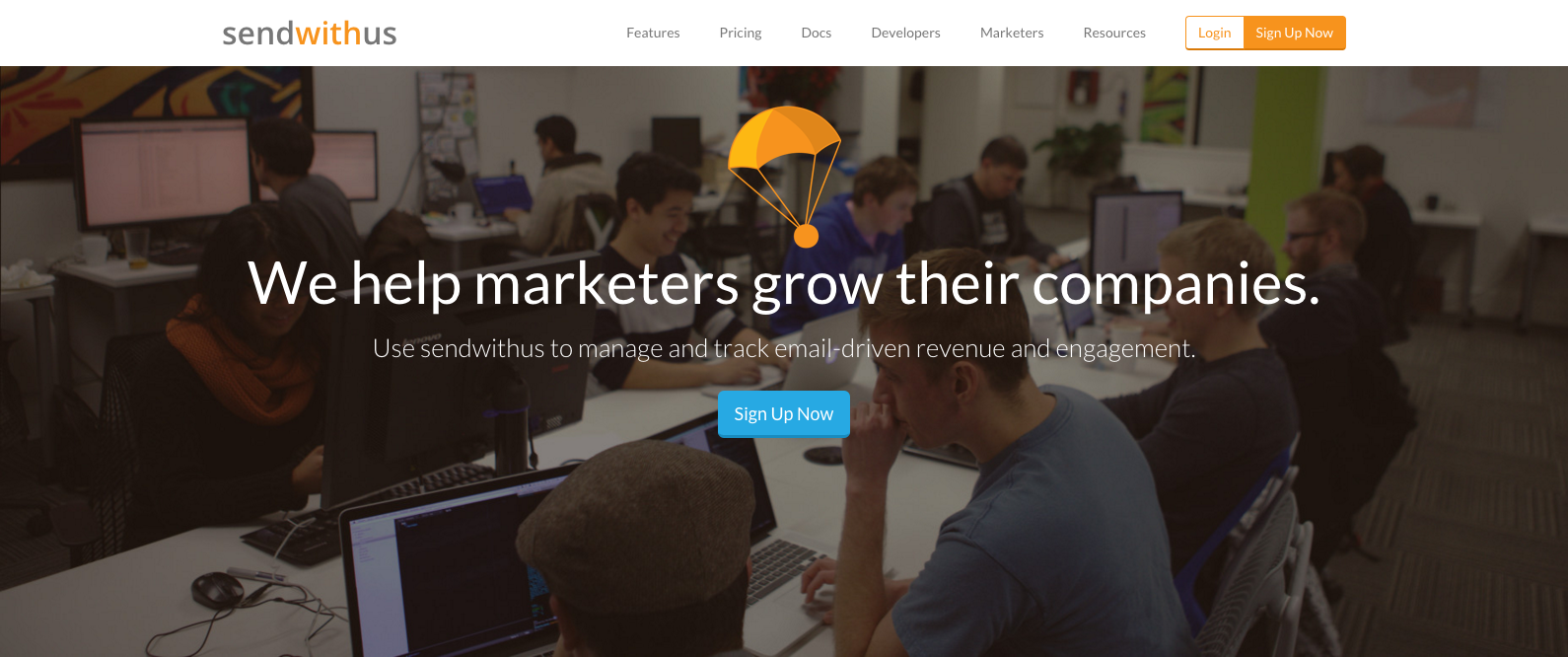
Here’s an example from the company, Send With Us. Their target audience is marketers. A marketer’s biggest challenge is they can’t get anything done without the help of a developer.
sendwithus.com/marketers
They might write their main objective like this:
- Target audience: marketers.
- Main point: Send With Us helps marketers edit transactional emails without a developer’s help.
- Main promise: marketers will get more engagement and revenue.
In this case, the page’s objective is to have visitors sign up for a trial.
Sections of a landing page
Headline + Sub-headline
The first thing people read is your main headline. Don’t waste it! It’s your way to hook people’s interest. Ask these questions while forming your headline and sub-headline:
- Who is this for?
- What’s their dream of a better life?
- What obstacle stands in their way?
- How do you help them overcome that obstacle?
Use “you” language
The headline is not the place to introduce yourself. Instead, address your audience directly by using (or implying) the word “you.”
Here are a few examples of bad “we” focused headlines:
- “Corporate gifting by Sesame.”1
- “We make interfaces.”2
- “Lita Healthcare Group Limited is a diversified healthcare company which markets and distributes products to the hospital and retail healthcare environment.”
On the flip-side, here are some good audience-focused headlines:
- “Accounting made for you, the non-accountant.”3
- “You don’t need to be an engineer. Build your startup by pointing and clicking.”4
- “Guaranteed to increase your organic search traffic.”5
Use verbs
Improve your headlines by using a strong verb. Without a primary action, headlines feel like generic descriptions:
- “Dead simple time tracking.”6
- “Real-time customer activity all in one place.”7
- “Meet the world’s first visual CMS.”8
Here are headlines that make good use of verbs:
- “Create professional client proposals in minutes.”9
- “Record bugs easily.”10
- “Send with confidence. Build, test, and monitor your emails with Litmus.”11
Landing page body
Now we get to the meat of the page. Follow this checklist while crafting your content for the body:
- Put a visual near the top. An image or a video can help people imagine themselves using the product. Images that create an emotional response are particularly helpful.
- List the benefits: in what ways does your product help your audience?
- Show social proof. Are notable people using it? What trusted news sources have written about it?
- Describe some (not all) of your features. Remember to describe the product itself! List a few features, and describe what makes them unique.
- Call to action: what is the conversion event for your page? If it’s to get people signed up for your list, feature your sign-up form prominently. If it’s to get people to buy, focus on your pricing tiers and “Buy Now” buttons.
Footer
Keep the footer simple. You don’t want to give people too many reasons to click on a link and leave the landing page. Start with three links and/or short content sections:
- About: who is behind this project?
- Blog: link to your blog.
- Contact: provide a way for people to contact you to ask questions.
Focus on the words
Jason Fried, the founder of Basecamp, has a great metaphor for building landing pages:
I’ve got to start with the words; the story has to be right. You can launch with just words.
Before you work on the design, images, and formatting, focus on the words. Here is Jason’s template for writing landing pages:
What
What feature/product are we talking about?
Why
Why does the audience care?
The pitch
A short paragraph that sells the “What” to the audience.
How it works
A description of how the feature works
Case study: Bidsketch
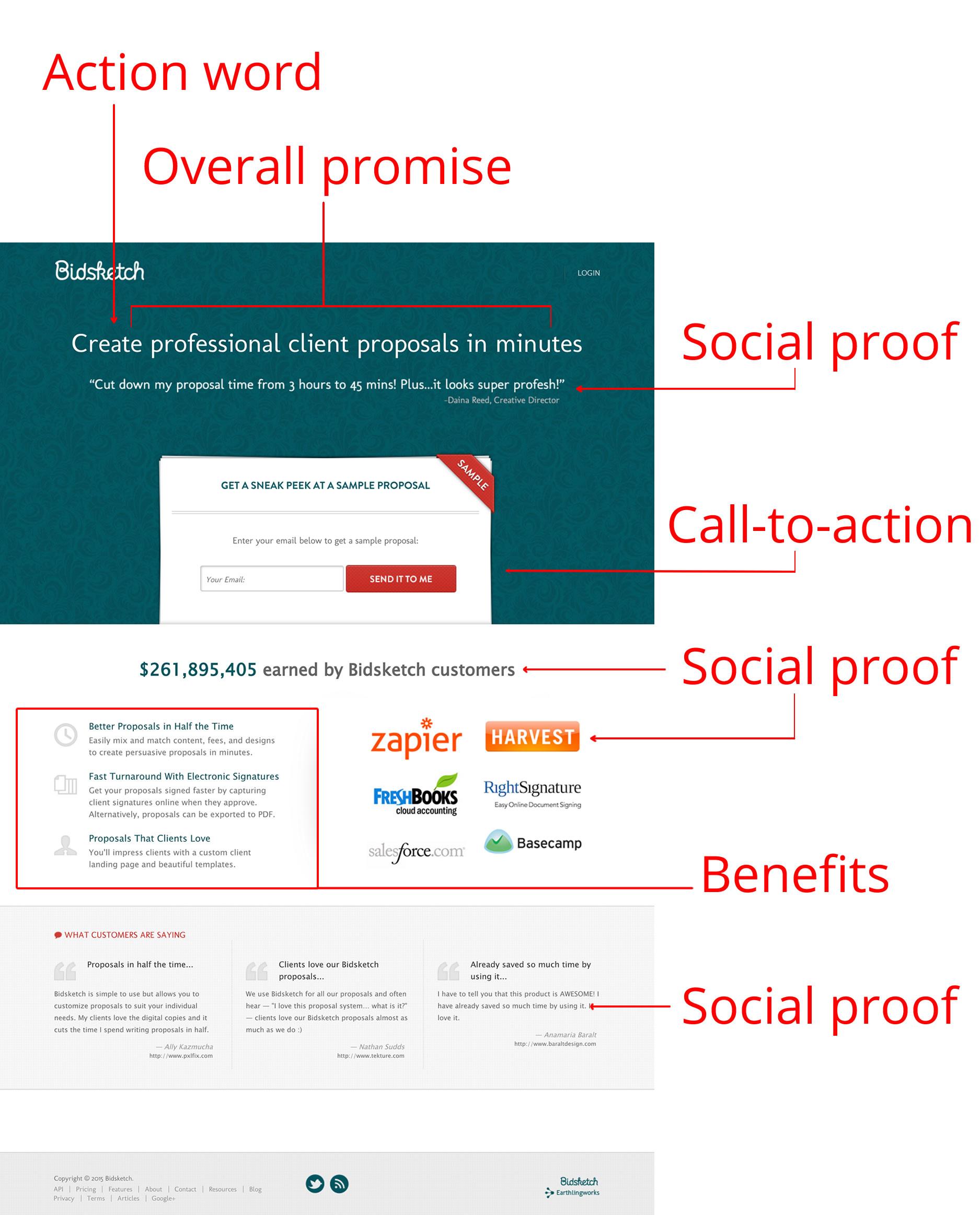
Here is the Bidsketch landing page. Pay particular attention to how they leverage social proof.
bidsketch.com
Reuben, the founder of Bidsketch, is emphasizing two promises to business owners:
- Bidsketch will save you time: “Create professional client proposals in minutes.”
- Bidsketch will make you money: “$261,895,405 earned by Bidsketch customers.”
The page is minimal, lightweight, and focused on one goal: getting people to sign up for a sample template.
For more landing page inspiration, you can visit www.landingfolio.com.
Footnotes
Buy the EPUB & PDF to read offline and support the work.
Buy the book — $10