III. Before You Launch
Set a price
Setting a price for your product can be the most difficult part of the marketing process. Here are three techniques to get you started.
Price based on value
One way to sell your product is to show customers how it can make them money, save them money, or save them time. You’re not selling an ebook, a web application, or a certain feature: you’re selling an outcome.
Choose your price by extrapolating what someone would pay you to help them achieve their goal.
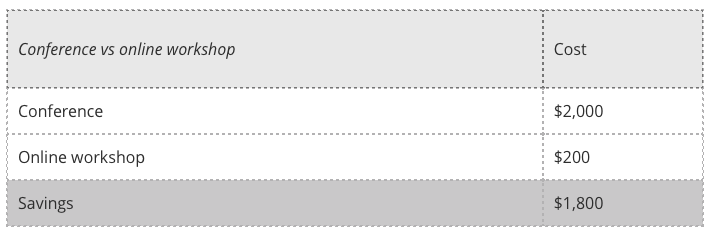
One method of doing this is the 10x value proposition: provide the same value as the current solution but for 10x less. For example, instead of going to a $2,000 conference, a customer could buy your $200 online workshop.
Price based on LTV
Lifetime value (LTV) - cost per acquisition (CPA) = profit
To make a profit, you’ll need to earn more money per customer than it costs to acquire that user.
For a single use product, the lifetime value of that user will usually be the price they paid. So, if a customer buys a book from you for $20, then that customer is worth $20.
The calculation is different for products with recurring revenue. Here, you multiply the monthly price ($20) by the number of months a typical customer pays. If the average user pays for 12 months, your LTV would be 12 x $20 = $240.
Once you know customer LTV, subtract the amount it cost you to acquire that customer (CPA). So, if you spent $2,000 marketing your new online workshop, and 16 people bought, your CPA was $125. If you’d set a price of $200 per attendee, your profit per customer would be $75 (or $1,200 total).
Price using tiers
Gumroad1 is an online marketplace for makers. They’ve done a considerable amount of research on the effect of pricing on revenue. One result: products with pricing tiers generated five times more revenue than those without.
“Your audience is a spectrum. It’s everyone from people who just found out about you, all the way up to super fans. If you’re only releasing products at one price point, you’re missing a huge part of that spectrum. The top 1–2% of your audience would be willing to buy [an expensive] package if you made it available to them.”
- Ryan Delk, Gumroad
The tiers that Ryan recommends are as follows:
- Low tier: this is your base product. If you’re selling a SaaS, this is likely your $29 tier.
- Middle tier: this should be 2.2–2.5x your lowest tier.
- High tier: this level is priced at 5x your lowest tier and offers the most value. It should contain all your features.
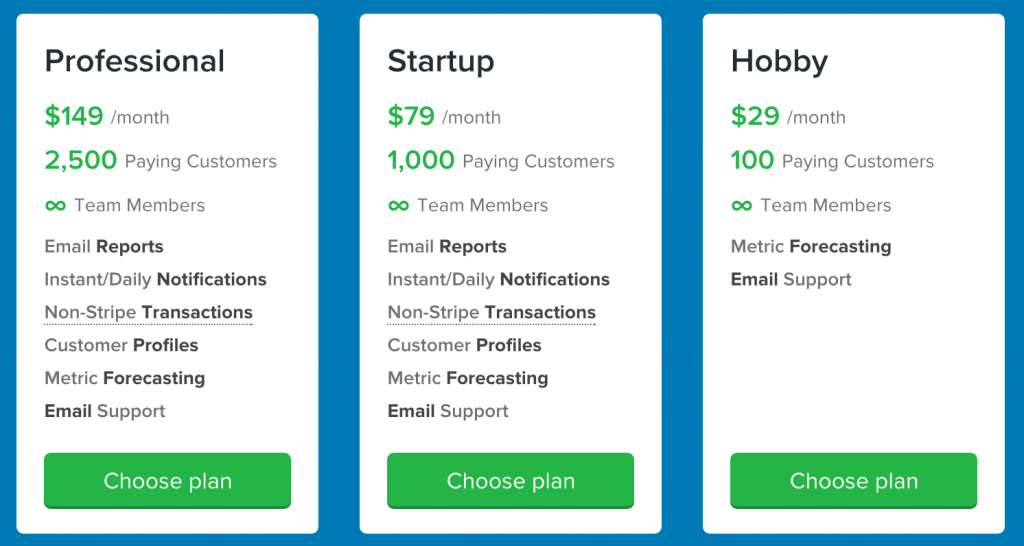
Baremetrics’ pricing loosely follows the 1x, 2.5x, and 5x pricing strategy
There’s anchoring psychology at work behind tiered pricing. The initial anchor price influences people’s perception of value.2
“People make estimates by starting from an initial value.”
- Kahneman, Slovic and Tversky, Judgment Under Uncertainty
Humans are wired to make comparisons. Provide them with only one price, and they’ll go and comparison shop. Give them three prices, and they’ll often make their decision at the moment. They use the context that’s available instead of referencing an external source.
There’s a certain group of people that will always buy the most expensive option. Duke University did a study where they offered students different groups of beers, all priced differently. 10% of students always bought the most expensive option.3
Footnotes
-
gumroad.com ↩
-
Orr, D. & Guthrie, C. (2005). “Anchoring, information, expertise, and negotiation: New insights from meta-analysis.” Ohio St. J. Disp. Resol., 597, 21. SSRN 900152 ↩
-
Adding Asymmetrically Dominated Alternatives: Violations of Regularity and the Similarity Hyopthesis, Joel Huber; John W. Payne; Christopher Puto, The Journal of Consumer Research, June 1982 ↩
Buy the EPUB & PDF to read offline and support the work.
Buy the book — $10